Today, I’m excited for the first day of the new month. Today marks the beginning of [Australian] winter and more importantly the day my mobile data finally resets after I depleted all my data last month. It also marks the beginning of Pridemas Season starting June 1. In the words of my friend Reuben:
Pridemas consists of two main parts. First and most general is the month of Pride, which is referred to as Pridemas collectively. Second and more specific is Pridemas Day on June 28, the anniversary of the beginning of the Stonewall Riots, and the following 3 days, collectively known as the Feast of Pridemas, which end the month of Pride.
Some of you know that over the last few years, I’ve come to having a surprising fondness for a liturgical approach to ‘holy seasons’ like Advent. I love the shared rhythms of marking the anticipation of Christmas with embodied practices that are loaded with spiritual and historical meaning and connect us to a bigger story: not just the big-picture gospel story, but the story of our own forebears as we echo the words and practices of previous generations of our spiritual ancestors.
This year, I’m thrilled to observe a Pridemas liturgy for the first time. I came across this liturgy last year a little too late for Pride month, and I’ve been eagerly anticipating June 2024 to finally start it. This liturgy was spontaneously brainstormed by a group chat of queer Christians channeling a delicious marriage of silly, serious, and spiritual ideas, and let me tell you, every time I have read this document it GIVES. ME. LIFE. So much life and so much queer joy.
Check out the Pridemas liturgy at this link, print a copy for your coffee table, and share around as you like. It’s beautifully rich in biblical themes, liturgical roots, queer history, liberation practices, and of course some hilarious inside jokes from our community (let the reader understand).
Here’s a little teaser:
Observing Pridemas can be done as follows.
On the first night of Pridemas, light at least one candle in celebration of queer light. As with every other observation and rite of Pridemas, feel free to repeat this every night, because since when did Mother’s Children settle for less on the liturgical and ceremonial end of things? As you light your candle, usher in Pridemas with a recitation of the holy Scripture:
“And God said, they will be lights in the expanse of the sky to provide light on the earth. And it was so.”
On the second morning of Pridemas, ceremonially open all closets within your house, including cabinets if you want to.
There will, of course, be lots of well-intentioned Christians who feel uncomfortable with the idea of celebrating Pride. There are lots of possible reasons for this, enough to remind me to hold a nuanced posture of openness to those who see things differently.
- For many of us queer folk who grew up in the Church, we may feel so disconnected from our own history and culture that we don’t really understand what Pride has meant to the queer community beyond some loud ‘n’ proud marches and rainbow flags that don’t particularly resonate with our own experience. We may not understand the liberation movements Pride represents or how different our lives would be now without them. Pride might therefore feel irrelevant or unnecessary.
- For some of us, Christian subcultures and their particular use of language make words like ‘pride’ hard to embrace without a sense of guilt that we’re affirming something the Bible calls a sin.
- Many of us feel disillusioned by ‘rainbow capitalism’ that has appropriated culturally significant symbols like Pride to dilute and distort its meaning into something we’re not interested in anymore.
- Some of us might not feel much solidarity with mainstream queer culture and may feel the emotional discomfort of something unfamiliar that heightens our felt sense that we’re not that kind of gay. We may even use different labels to differentiate the fact that we don’t identify with what ‘gay’ or ‘queer’ means in a mainstream sense.
- And of course, many Christians will have a conscience issue with any celebration of queerness, viewing queerness as a result of sin (whether that means viewing queerness as sinful in itself, or viewing queerness as a tragic but morally-neutral defect which some are afflicted with until the resurrection life ‘heals’ us). For people who hold either of these convictions, it’s logically consistent to view celebrations of queerness as inappropriate. [For the record, I disagree with this position, but I do want to acknowledge its prevalence, its internal consistency, and the honest intentions of the people holding it.]
There’s a plethora of other thoughtful resources exploring the question of whether queer Christians can/should celebrate Pride, and I’m not going to rehash those arguments here today. This is one month we should enjoy a break from the relentless self-advocacy (see the great Pridemas fast in the liturgy linked above!). But I love this graphic a church friend put together for our Pride-themed Queer Worship Night which so succinctly captures the Pridemas spirit, deftly integrating theological insights with themes from queer liberation history: because those two things should never have been at odds with each other.
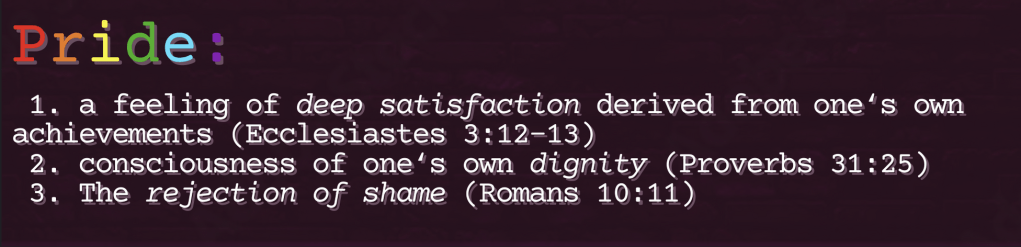
This year I’ll be observing Pride, and I hope to do so both queerly and Christianly. I’ll be observing Pride as
- A celebration of diversity
- A commemoration of sacrifice
- A liberation story
- A declaration of dignity
For those who want to engage in good faith on this topic, I’ll be writing about each of these aspects over the coming month and weaving some of these threads in with key themes from the Christian gospel story. I believe each of these aspects offer queer Christians (and our world) fresh images for connecting with the gospel story as these four themes of queer history mirror four chapters of salvation history: Creation, Fall, Redemption, and Glorification. Stay tuned for more thoughts!
Happy Pride to all who celebrate!

 Singled Out