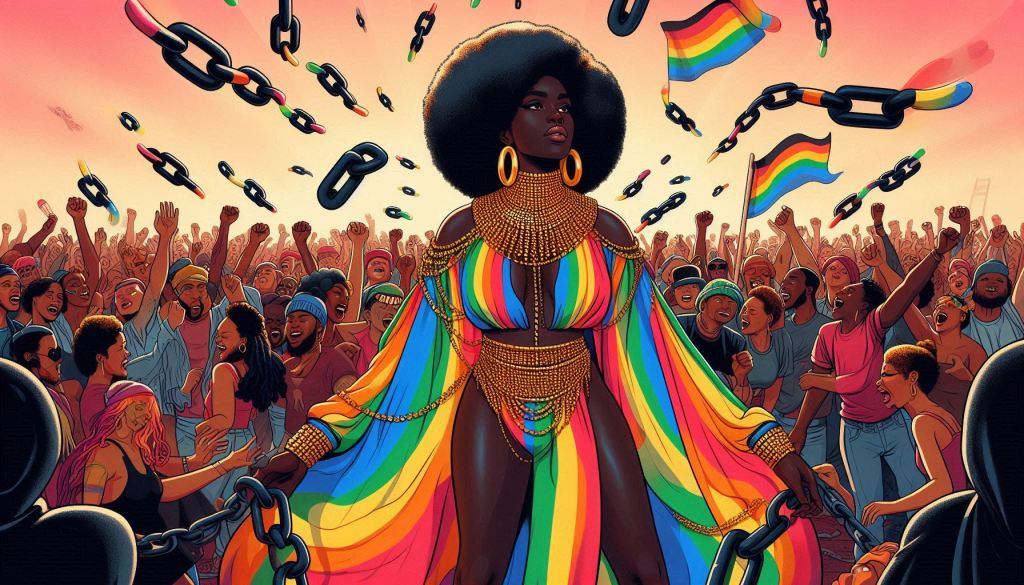
This is a sacred day. While in my time zone it’s already June 20th, right now my siblings in the US are currently celebrating Juneteenth. June 19th marks the day formerly enslaved Black Texans learned of their liberation (some two years after the Emancipation Proclamation declared them free without their knowledge in 1863). “It was not until Union soldiers arrived in Galveston, Texas, on June 19, 1865, that the state’s residents finally learned that slavery had been abolished. The formerly enslaved immediately began to celebrate with prayer, feasting, song, and dance.”[1] From the beginning, these liberation celebrations (also known as Jubilee and Emancipation Day) featured the intersectionality of Black spirituality: “original observances included prayer meetings and the singing of spirituals, and celebrants wore new clothes as a way of representing their newfound freedom.”[2]
Many Christians have seen in this particular liberation story a picture of spiritual realities, like Lecrae’s powerful introduction to this album Jubilee:
Like Lecrae points out, without knowledge of their emancipation, people remained functionally enslaved for years until the good news reached them. He also alludes to the experience (a key theme throughout this album) of people forgetting or doubting the reality of their freedom and feeling pulled back towards that old way of life. I wonder if this is part of the heart behind present-day Juneteenth celebrations like this album: people need ongoing reminders, the inescapable declaration of their liberation and all that this new identity entails.
It’s a struggle that’s not unique to Black folx, but an ancient struggle and a spiritual struggle. It reminds me of this line from a 2,000 year-old letter written by a Jewish man to a minority community in ancient Turkey “It is for freedom that Christ has set us free. Stand firm, then, and do not let yourselves be burdened again by a yoke of slavery.” (Galatians 5:1). That community needed ongoing reminders that they were made for the Life of Liberation, and the rest of the letter explores that life with a more vivid vision (see especially Galatians 5:13-26).
I’ve found myself captivated by Black Christians’ practice of seeing within historical liberation movements the divine work of a liberating God—and on the flipside, finding echoes of their own community’s experiences in their reading of the Bible’s story. One of my favourite songs in the above album (Spotify tells me I listened to it 29 times last month, and I only discovered it halfway through the month…) is a bangin’ liberation anthem that repeats the line “this is my Exodus,” referencing the story of God’s rescuing of enslaved Hebrews in Egypt. Black Christians have long seen Black liberation as a new Exodus, an act of God who heard the cries of his people… and that’s gotten me thinking about what it might look like to recognise God’s hand at work in our world in other areas.
I’ve been thinking about the historical roots of Pride as a liberation celebration (the first Pride rally in 1970 was literally called ‘Christopher Street Liberation Day’), and this might get me in [more] trouble with the conservatives, but I keep thinking, what if we recognised more of God’s hand in human history and saw in queer liberation movements something of God’s divine purposes?
I’m not saying these movements are faultless or Christian, and I’m certainly not saying that God’s involvement in human history equals an indiscriminate endorsement of everything that took place in those social movements! But what if historical declarations that these queer bodies have inherent dignity is something God had a hand in all along? What if the loud insistence on queer people’s human rights is a visible expression of the Spirit’s work expanding Jesus’ Heavenly Kingdom throughout this world and transforming systems of injustice?
As I’ve entertained this possibility, the main shift in my perspective has been realising that the magnitude of God’s saving work may be far bigger, far more concrete, far more comprehensive than I’d allowed myself to imagine before. I didn’t use to think that the gospel had any bearing on queer incarceration, but what if when Jesus promised to bring “freedom for the incarcerated and liberation for the enslaved” (Luke 4:16-21), he like… actually meant exactly that?
This is why celebrating Pride has become so important to me this year: because on some level, I believe that the decriminalisation of queerness, the protest against police brutality and unjust incarceration, the insistence on the dignity of queer lives is an act of God working in human history. I can pay respects to my queer ancestors for their sacrifices AND worship my Liberator for the ways I see the nature of the Heavenly Kingdom restoring human dignity in real time.
If our only vision of queer flourishing is a godless one, we are missing out on the Liberation Life we were made for.
Most of my life I’d perceived celebrating Pride as a godless activity, something that I should feel guilty about as a Christian. But I wonder if we’re missing out by withdrawing from these celebrations. If our only vision of queer flourishing is a godless one, we’re missing out on the Liberation Life we were made for. When we keep God’s name out of these celebrations of human liberation, we fail our world, and we fail to display the scope of God’s saving power to transform and revitalise every area of human culture. We fail to give God the credit he’s due.
God our Liberator deserves better!
God our Liberator deserves a celebration with singing and dancing and feasting and brightly coloured decorations. Jesus taught us that when even one precious lost one is brought home to freedom, all of heaven throws a cosmic party to celebrate (Luke 15). He describes a party so spirited it includes sumptuous feasting, putting on fancy new outfits and jewellery, and pumps out such vivacious music and dancing that the party can literally be heard down the street.
It’s time for us to join the party!
Joining the party is healing. There’s healing in joy and laughter, in worshipping our Liberator, but more than that, we need the rhythm of embodied reminders that we are, in fact, free. I was struck by the description of early Juneteenth celebrations above where Black folx put on bold and bright new clothes to represent their newfound freedom.
I feel the need for that in my queer body. We need communal celebrations where we put on new garments—clothes in loud rainbow colours and funky jewellery that remind us of our new way of life. We need dinner parties where there’s a place for us at the table to not only break bread together but eat celebratory cake. We need dancing and singing and a bit of Silly Goose time to remind ourselves that even with all that’s wrong with the world, we are a people with inherent dignity, that queer joy is resistance enough for today.[3]
Queer joy is resistance enough for today.
[1] https://www.britannica.com/topic/Juneteenth.
[2] https://www.britannica.com/topic/Juneteenth. See also 2 Corinthians 5 and the biblical theme of ‘putting on’ new clothes as an expression of new life and reconciliation that comes from the Spirit’s liberation of those who were enslaved.
[3] I think we could learn a lot from the movement of ‘Black Joy.’ See https://nmaahc.si.edu/explore/stories/black-joy-resistance-resilience-and-reclamation.

 Singled Out