As I mentioned in my last post, this Pride month, I want to offer some devotional reflections on key themes of Pride and share how they’ve helped me connect freshly with different aspects of the gospel story.
The first theme is Celebration—or more specifically, Celebration of Diversity. Putting aside for a moment Christian concerns about Pride being a ‘celebration of sin’ (usually stemming from a view that hypersexualises queer people), at the heart of Pride celebrations is an insistence on the beauty of humanity’s expansive difference.
In a world that says, “We’re not that different, so you should love and accept me,” queer celebrations declare, “I may be nothing like you, but I am worthy of love and acceptance.”
In a world that says, “We’re not that different, so you should love and accept me,” queer celebrations declare, “I may be nothing like you, but I am worthy of love and acceptance.”
Queer culture challenges dominant cultural narratives when it insists on the inherent worth of all human lives, regardless of ability (or desire) to conform to majority expectations. We see beauty in humanity’s diversity and celebrate that, even within our own community, we have radically different experiences.
Queer communities at their best* are a rare example of a community defined not by what we have in common, but by the absence of a certain majority experience. As a celibate gay Christian man, I have remarkably little in common with a trans nonbinary person, aromantic-asexual experiences of love, a bi woman’s experience of marriage to a straight man, or the relationship of older gay men who grew up in a different generation where their relationship was criminalised. Yet I gathered with all these people (and more) in a queer worship night last weekend in what felt like a bizarrely but beautifully diverse community.
I’ve noticed even the language and symbols queer communities have been moving towards reveal in themselves a certain value of diversity: rainbow imagery has become the quintessential symbol of diversity, where every colour is interdependent on the others to collectively radiate the full brilliance of human lives. We’ve also been moving away from language like ‘gay culture’ that only reflects a single aspect, instead moving towards the inherently diverse ‘LGBTQIA+,’ then eventually just ‘queer’ where we don’t even attempt to list every experience of our community but instead just lean into the fact that we embody different-ness, strangeness, ‘queer’-ness in the original sense of the word.
This month I’ve been reflecting on how this cultural value of diversity testifies not only to the varied brilliance of human life, but also the imaginative artistry of our Creator. I keep thinking about the Christian Creation stories and how they portray the genius of a Creator forming humanity all alike in being divine reflections of Their image, yet remarkably different from one another.
One of the insights of field of disability theology has been most paradigm-shifting for me is that the biblical Creation story challenges the idea that there is such thing as THE ideal human body.[1] Despite our ableist assumptions that a certain body type is closer to a creation ideal and all divergence from that ‘ideal’ are deformed, disability theology overturns these assumptions and points out that from beginning to end, the Bible depicts a humanity that embodies diversity as a good and glorious reflection of our infinite Creator.[2]
This perspective has helped me read the Creation story differently. When I read the creation poem of Gen 1:27, I’m struck by the fact that, from the beginning, God created two different human bodies—a male and a female—so that no one could claim that one of these bodies is The Ideal Human (despite patriarchal distortions that have attempted exactly that).
God created humanity in God’s own image,
Genesis 1:27 CEB
in the divine image God created [singular] them,
male and female God created [plural] them.
It’s liberating to see in this ancient text a radical insistence on gender equality that declares not only that humans of all genders have equal standing as divine imagers, but that in our very gendered differences we have divine purpose: to collectively reflect the divine brilliance of an infinite God. By creating us in multiple genders, God made us interdependent on one another to fulfil humanity’s highest purpose: to encounter God’s resplendence and reflect that light in our world in myriad ways.
To reflect and refract that divine light in our world.
When I was reflecting on this today, I found myself meditating on the imagery of refracted light. When light passes through an object like a prism or waterfall, the light rays change speed and direction, splitting the light ray apart into a whole colour spectrum. What originated as a beam of light is refracted into its component parts and transfigured into a rainbow.
I find this imagery a deeply compelling way to think about what it means for us to live as God’s divine imagers. We are finite creatures, and no one of us can adequately embody the full radiance of cosmic Divinity as an individual; it’s like the ray of divine light beaming down onto humanity and effusing us with life is refracted into a thousand different shades of sparkling colour.
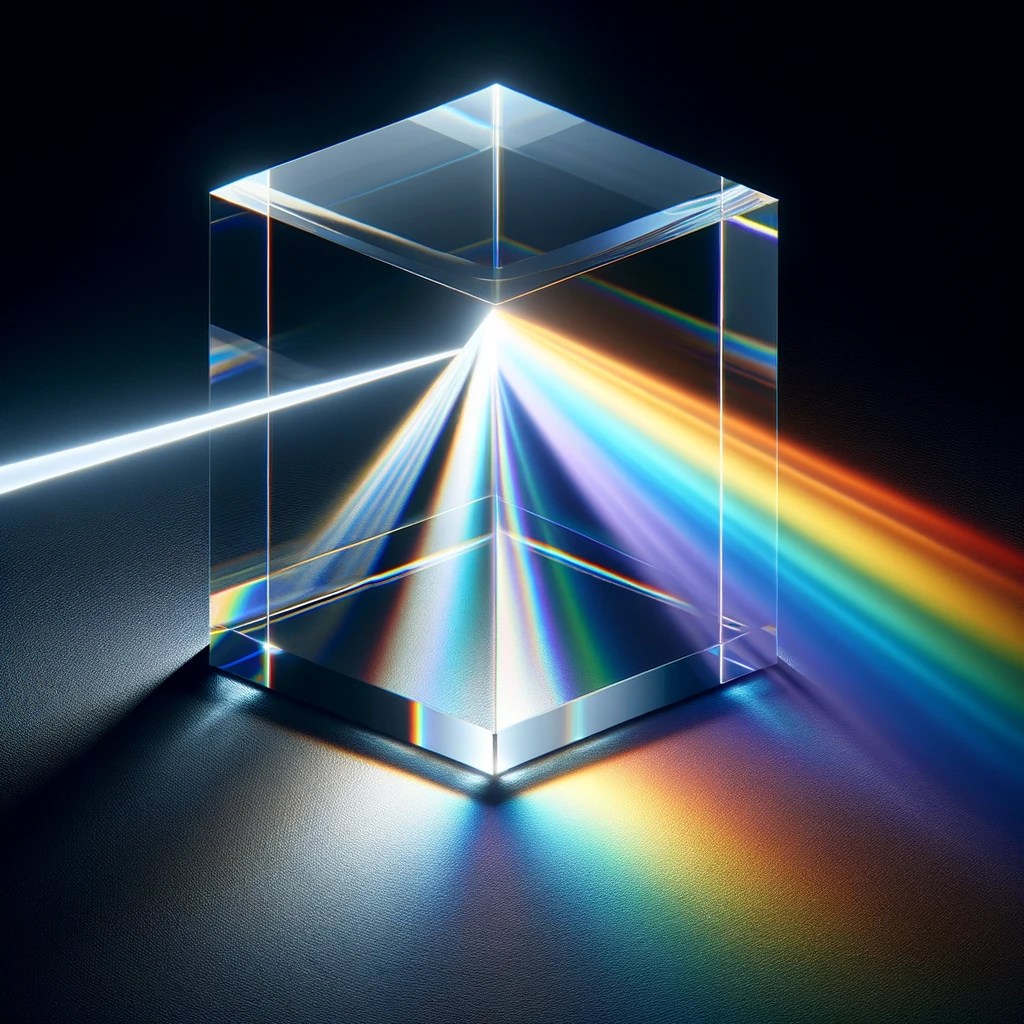
Every single hue on that colour spectrum is a true reflection of God’s nature, and yet it does not and cannot tell the whole story. To paraphrase the Apostle Paul: a Magenta cannot say to a Turqoise, ‘I have no need for you.’ But God has artfully designed the entire colour spectrum, giving greater dignity to the parts that lacked it, so that there should be no division in his Cosmic Artwork, but that its hues should have equal concern for each other (cf. 1 Corinthians 12:21-26). To mirror our divine Light source, we need the whole of collective humanity each uniquely radiating back a different hue of that refracted luminescence.
I think that’s why biblical imagery of a renewed humanity features an ever-expanding multitude of diversity: people from every country, subculture, ethnicity, language, gender, social class, and body type or ability. What started as dimorphic origin story (a man and a woman in a single part of the world) expands to fill and bless the earth with the expanding Kingdom of God in all its diverse representations. My friend Bec shared this passage last week reflecting on our Queer Worship Night Pride celebrations as a foreshadowing of cosmic heavenly worship:
9 After this I looked, and there was a great crowd that no one could number. They were from every nation, tribe, people, and language. They were standing before the throne and before the Lamb. They wore white robes and held palm branches in their hands. 10 They cried out with a loud voice:
“Victory belongs to our God
who sits on the throne,
and to the Lamb.”11 All the angels stood in a circle around the throne, and around the elders and the four living creatures. They fell facedown before the throne and worshipped God, 12 saying,
“Amen! Blessing and glory
Revelation 7:9-12 CEB
and wisdom and thanksgiving
and honor and power and might
be to our God forever and always. Amen.”
My prayer and joy this month is that all human celebrations of diversity would see in ourselves something of the beauty of God’s face. May we learn to see the divine image in each other and thank God for it.
For further devotional reflection, I’ve been enjoying this song today and praying through it. May it bless you too! I’ve also linked a video of my friend and coworker reciting a fresh interpretation of Genesis 1 that felt too topical not to share. Go give them a follow on Boy Renaissance!
* I recognise that often, even most of the time, real-life queer communities can fail to embody this ideal and begin to mirror the tribalism and conditional acceptance of our world. The experience of people like my trans nonbinary, disabled, POC Christian friend is that most queer spaces have still been unsafe for them, whether because of racism, transphobia, ableism, accessibility, anti-religious hostility, or other barriers that prevent intersectional inclusion in a community that professes these values. Similar to my critiques of evangelicalism, I feel the need to hold in tension both the fact that a community holds professed values that I wholeheartedly support, AND the reality that this community is often hypocritical in living up to those values.
[1] Of course, the exception, in some manners of speaking, is the incarnate Jesus who is, “the radiance of God’s glory and the exact representation of his being, sustaining all things by his powerful word.” (Hebrews 1:3). As the supreme “image of the invisible God” (Colossians 1:15), the divine-human Jesus can radiate God’s glory in a way no other human ever can.
However, even conservative Christian theology these days generally accepts that, with regard to his humanity (which is, by definition, finite), Jesus’s human male body does not embody the sum total of all human expressions of God’s image. [Cis] Female bodies are not further from the divine image for not being the same form as Jesus’ body (despite some dicey moments in church history arguing otherwise), and Jesus’ status as the ideal human does not nullify the need for human diversity to reflect God’s infinite glory.
That said, glory where glory is due: what a privilege it is to see God’s divine light embodied in a flesh-and-blood human! Today I’m reflecting on this line from Silent Night about the infant Jesus’ glory: “Son of God: Love’s pure Light | Radiant beams from thy holy face.”
[2] I can’t summarise the entire field of disability theology with the nuance it deserves, but for anyone interested in diving deeper into it, I would recommend reading Receiving the Gift of Friendship: Profound Disability, Theological Anthropology, and Ethics by Hans Reinders, or for a shorter article, Hans Reinders, “Understanding Disability and Humanity: Probing an Ecological Perspective?” Studies in Christian Ethics 26.1: 37-49.

 Singled Out